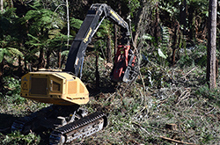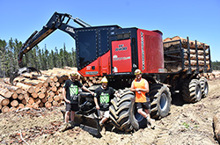


While there are many winch-assist units out in our industry supporting felling and bunching on steep terrain, winch-assist skidding is a lot less common, says the University of Canterbury’s Prof Rien Visser.
He continues: “Under the right conditions winch-assist skidding allows us to operate on what was traditionally cable logging terrain, however, our understanding of its full potential is still somewhat in its infancy. Within the scope of the Forest Growers Research Harvesting programme, some initial productivity studies were done in 2019. The more successful one was with Blake Speirs in Gisborne where he was operating his Tigercat 635G on 30 degree slopes – supported by a Falcon winch.
“Operations Manager at the time, Dan Fraser from FEL, noted that not only the safety, but productivity and cost efficiency were attractive, it also allowed them to pull away from waterways, achieving an improved environmental outcome.
“The earlier excavator-based winch-assist units were designed to support the slower moving tracked falling machines. Hence, some teething problems were expected at the time with issues such as the skidder being able to overrun the line speed, or being able to adjust the tension setting for the skidder heading out empty. Six years on and the commercially available winch-assist systems have adapted to support skidder operations as well.
“So now was a good opportunity to restudy winch-assist skidding. Ian Wilton of FORCO, who manages T-Winch sales in Australasia, mentioned that one of the best crews making winch-assist skidding its preferred extraction method was NJP Logging and Tree Services, operating out of Colac west of Melbourne. The crew owners, Nathan and Carla Peters are Kiwis, making their start logging in Northland and West Auckland before working for Treescape.
“Nathan runs a John Deere 959 self-levelling feller-buncher and a Tigercat 635D six-wheeled skidder, with the T-Winch 30.2 providing the winch assist. He has successfully recruited many of his operators from New Zealand.
“In addition to myself, our two university summer students Yotam Perchig and Noa Visser came along to support the data collection. The productivity study spanned three days, starting off very wet. However, by day three the sun was out, the ground drying rapidly and the change in conditions made a difference in ease of operation.”
To read more, get your copy of the March 2026 edition of NZ Logger magazine, on sale from 2 March. Check the link on this page to subscribe to either a printed or digital copy (or both).