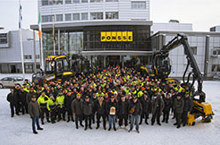


Close to 200 Foresters gathered in Rotorua earlier this week for the HarvestTECH & Wood Transport Logistics 2026 organised by Innovatek.
The first and address was by Mike Casey who spoke on Energy Resilience for Forestry Supply Chains — Learnings from Other Sectors.
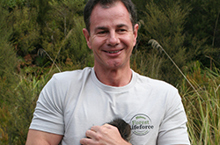
As well as being a cherry grower from Central Otago, Mike is CEO of Rewiring Aotearoa, a New Zealand charity dedicated to electrifying millions of fossil fuel machines across the country as quickly as possible. He began by admitting he knows very little about forestry.
“I am very, very passionate about New Zealand-made energy and what it could mean for our economy and for our people,” he said.
While he would like his cherry orchard to be known for the taste of its produce, that isn’t necessarily the case. “What we have become known for is the fact that we run our farm on 21 electric machines. That's no diesel, no gas, absolutely everything on our farm is electric.”
He said to run all diesel vehicles would cost around $50,000 in diesel a year. With his orchard, he has demonstrated energy costs can be further reduced by installing solar panels.
He is concerned about the amount of energy brought into New Zealand.
“The biggest problem that I have is that just over half of the energy that we use in our economy is energy that is imported from the other side of the world, and that I don't think is in New Zealand's best interest.
“This is actually just raw economics right. It's really expensive. Every day you and I and our fellow New Zealanders spend $55 million dollars on energy we import.”
He said that energy in the form of oil, petrol and diesel, is used in about 10 million vehicles. Research by Rewiring Aotearoa has shown there are around 8,500,000 of them that could be electric with current technology, and another million are almost ready to be electrified.
“I talk to farmers all the time and they'll be like, you can't electrify my 250 horsepower tractor, and you can’t, right? That is part of the 700,000 machines in New Zealand that are simply not ready to electrify yet.”
Many of those machines will be in the forestry sector. He said his purpose wasn’t to try and convince delegates to electrify everything.
“What I'm going to try and convince you to do is just be electric curious. The next time you need to buy a machine, just investigate whether the electric option is cheaper over its lifetime than the fossil fuel equivalent.”
He said there are already electric machines in Australia that are breaking world records on the amount of material that they can shift.
“One thing that's really interesting is seeing how the mining industry in Australia has now flipped from the idea of doing hydrogen, over to the idea of using electric machines, even for the big things.”
There are e-machines available in New Zealand and “a bunch of cool things are on the horizon for the forestry industry”.
He said there are 16 loaders in New Zealand that are fully electric, three of which are working in the forestry or wood processing sectors.
“These are among the million machines that I would now consider almost ready to electrify, and leaders in your industry are starting to pick them up.”
He recognised that one of the industry’s challenges is the remoteness of some operations.
“How do you get the energy to these big machines? That's a challenge that we need to think about. This sort of stuff is really on the horizon now.”
One option is mobile solar panels.
“We have a couple of these systems, I think, in New Zealand where people are taking the power generation to remote areas and they're picking it up and they're taking it away somewhere else when they need to.
“We have batteries on trailers now, so people can tow the power to the machines that need them charging quickly.”
There are also charging trucks.
“That’s pretty cool when we start to see this sort of stuff coming to fruition.”
He says the technology coming out of China is remarkable.
“And the one thing that makes me very excited about it is the fact that it enables us to run on the energy that we can create ourselves.”