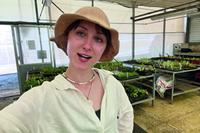
 Wāhine in Forestry gave five University of Canterbury School of Forestry students the opportunity to attend August’s New Zealand Institute of Forestry Conference in Dunedin. NZ Logger editor Stuart Whitaker spoke to each of them about their background, reasons for studying forestry and their impressions and takeaways from the conference.
Sylvia Gordon
I am 21, a second year Bachelor of Forestry Science student. Born in Chicago and raised in England, I moved to New Zealand at nine. I attended Burnside High School and Hagley College. No-one in my family has a forestry background, and I reached the end of my gap year without knowing it was a degree or profession.
What drew me to forestry was that it turns environmental responsibility into real decisions. It requires more than valuing forests, biodiversity and renewable resources in principle. It requires deciding what is established, where it belongs, how it is managed and used, and what remains afterwards. Those decisions shape living systems, landscapes and human outcomes over decades. Wood is a vital renewable material, but producing it sustainably requires accountability when environmental, operational and commercial priorities do not align neatly. That combination of science, judgement and responsibility is why I chose forestry.
My firmest direction is urban forestry, where the same seriousness enters the places people live. I want to combine fieldwork with technical assessment and planning in urban forest management, ecological restoration, tree establishment and GIS.
Most of my practical forestry experience has been through university so far, including forest measurements, restoration work and a group clearfell harvest plan.
Conference reflections
The Future Foresters quiz was such a fun way to start. I already knew forestry was broad, but the conference made me realise how many directions you can actually take it in.
Indigenous forestry was the biggest one for me. I had never thought of it as a specific profession before. Janelle Rice’s talk made me realise it can involve native forest ecology, sustainable management, helping landowners and working with policy and regulation. It brings together a lot of things I care about, so is now something I want to explore.
The other big surprise was how interested I was in the digital side of forestry. Dave Herries from Interpine spoke about GIS, LiDAR, drones, thermal detection and AI being used for things like forest mapping, wildlife monitoring and finding large woody debris after storms.
Even the policy and wood processing talks surprised me. I found the ministerial address really informative. It helped me understand how much policy affects what the forestry sector can actually do.
Rodney Lonneker’s opening talk stayed with me the most (see Rylee Kilsby-Port’s comments).
I had some really useful conversations with people from MPI, indigenous forestry and different forest management roles. I could ask what their jobs were actually like, what they had studied and how they ended up there.
Whirika Consulting’s Rhys Millar gave one of my favourite talks. His presentation probably lined up most closely with how I already feel about forestry. He spoke about the good environmental work happening inside forests and the importance...