 It’s the early 2010s, and Steve Evans learns that the earthquake-damaged Lyttelton wharves are heading for landfill.
Steve loves working with vintage timber and is shocked to learn this precious Ironbark’s worth isn’t being appreciated.
“When I heard that, it drove me nuts,” he says.
He sets about salvaging what he can to his 2.5 acre Oxford, North Canterbury, home and yard.
Fast-forward 15 plus years, and the value of the older timber is prized. When Steve is offered it now, it comes with a hefty price tag.
More care is also taken with removing the older structures to avoid unnecessary damage, which was a challenge with the Lyttelton Ironbark.
Luckily, Steve “can turn some pretty gnarly-looking hardwood into quite nice arty type pieces”.
Ironbark is an Australian hardwood, a type of Eucalypt that’s harder than Jarrah.
Steve says, “It’s such a versatile product. Even a big wharf pole that’s rotted out in the centre, with all its big wrought iron bolts and stuff in there, cleaned up, can look really quite attractive … for garden pieces.”
Worm-eaten product also cleans up well with water blasting. The holes add character, he says.
It’s hard to know what a piece of salvaged wood will look like once it’s opened up, but there’s not much Steve can’t work with, and turn into something beautiful, structurally useful, or both.
Some of the split pieces he resaws become beams in new builds.
A lifetime’s supply of wood
Steve has had a varied career, and began his working life as a baker. But he had always had an interest in hunting and possuming, and soon decided an outdoor job suited him better.
“I also like flying, so I combined my hunting with getting into flying … aerial hunting.”
From there, he spent a short time in Taupō, then Tauranga, where he did some commercial fishing, before ultimately settling in his current Oxford location.
Logging has featured in Steve’s past. He cleared a few of his own Old Man Pine and Macrocarpa shelter-belt blocks for dairy conversion; the logs were processed for firewood.
“And from there, we were doing (logging) a lot of farms around Oxford.”
While working on the shelter belts, Steve often helped landowners by removing collapsed farm buildings and was able to salvage Australian hardwoods and Oak in the process.
At that point, enquiries started coming in for landscaping material, and much of the logged Macrocarpa went in that direction.
“That’s when I first got interested in milling. And from there, we progressed into the earthquake period, which enabled us to source a lot of the damaged wharf material from Lyttelton.”
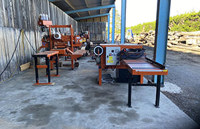
The sawmilling craftsman says he has more wood at his place than he’ll ever be able to work on.
Fireproof bark
Its resistance to water, insects, rot and its strength make Ironbark a popular choice for wharves, bridges, cladding and flooring, along with decks, beams and rafters. It has a reddish to dark brown colour and gets its name from its thick bark, which can withstand fire.
Steve’s aged timber is popular with high-end businesses and new properties where people are looking for a more...