Over the last two decades, a lot of effort and research has focused on improving cable logging systems.
This has been driven by the need to mechanise for both productivity and safety reasons, and also in recognition of the fact that, in many regions, harvesting has moved on to ever steeper terrain.
The list of improvements is impressive, with motorised grapples, winch-assist, mobile tail holds, advanced operating controls and even remote-controlled backline machines, all helping our yarding to be some of the most productive in the world.
As such, it is easy to overlook the “humble” skidder, which is still the number one extraction system in New Zealand. From the FGR Benchmarking system (Visser 2026), approximately 38% of the country’s professional logging crews use it as their preferred extraction system, and it extracts about 48% of all volume harvested.
To see exactly how the new skidders are pushing the limits of modern productivity, University of Canterbury School of Forestry’s summer research students, Yotam Perchig and Noa Visser, supervised by Professor Rien Visser, set out to gauge the characteristics of one of the most productive skidder harvesting operations in the country.
Based in Rotorua, Trimax Logging is a family-owned and operated stems ground-based operation that, when conditions are good, has a target of 1250 tonnes per day.
Owner Scott Saunders runs the operation alongside his brother, Casey. For the last two years Scott’s son, Fletcher, has joined the crew as well.
The production study focussed on the speed and capability of their modern skidder – a John Deere 948L-II Skidder operated by Casey. The rest of the team included a John Deere 959 and Komatsu 300, operated by Scott and Gareth Judd. There were also two Komatsu 300s, operated by Fletcher and Jake Gielen, which were primarily tasked with shovelling and loading the stems. On the landing was a John Deere 3156G loading stem trucks, operated by Shane Brabant.
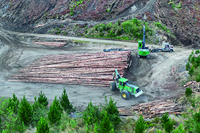
The crew was visited mid-February while operating at the back of Tarawera Forest, near the falls. But, because of the market, there was a limited production quota of 1000 tonnes a day – making for slightly shorter days. The crew was competently supervised by Gordon Anderson-Smith and Peter Auge from Manulife. Also, Gordon was able to put the drone up giving some excellent bird’s-eye footage of the operation (including the aerial photos seen here).
The block was certainly not easy, with plenty of steep terrain needing to be shovelled downslope to the designated skidder tracks. The average tree size was 1.9m3, with approximately 685 m3/hectare.
Efficient harvesting
The Trimax crew has put a lot of thought into making a very efficient harvesting system. The stems are delimbed at the stump and then shovelled, before being gathered into consistent five or six stem bunches. This creates a roughly 10-tonne load, and by bunching them into neat piles, they eliminate the time a skidder might waste trying to break logs free from a surge pile or struggling to grab the right number of stems. It ensures the skidder has a constant, “ready-to-go” supply.
A...