 The Automation & Robotics R&D programme at Forest Growers Research produces and deploys new technology to mechanise and automate forestry operations. In so doing, it aims to address growing labour shortages, rising forestry value chain costs and negative environmental impacts of harvesting; as well as improve the safety of workers.
 The nine-year, $22.2 million Automation & Robotics research programme started in 2019 and aims to revolutionise forest harvesting and logistics operations, making them safer, more efficient and more sustainable.
The value of scientific research and the benefits of both Forest Growers Levy Trust funding and government funding through the Ministry for Primary Industries (MPI) will deliver projected savings in harvesting costs from automation and value-chain efficiencies amounting to around $5.00 per cubic metre from 2030.
The programme leverages $6.5 million from Forest Growers Levy Trust funds with over $6 million of in-kind contributions from industry and direct funding from forestry companies and $9.6 million of Government funding through MPI investment. However, none of this work could be done without R&D support from Scion (the Bioeconomy Science Institute) and the University of Canterbury along with about 15 different technology developers and manufacturing partners.
Development of new automated technology
Many product innovations are underway, including:
- Commercially available remote-controlled felling wedges that enable forestry workers to fell trees from a safe distance.
- The automated quick coupler that enables rapid changeover of multiple attachments from within the cab of a single base machine so one operator can operate multi-function machinery. This technology is now commercialised and available for sale.
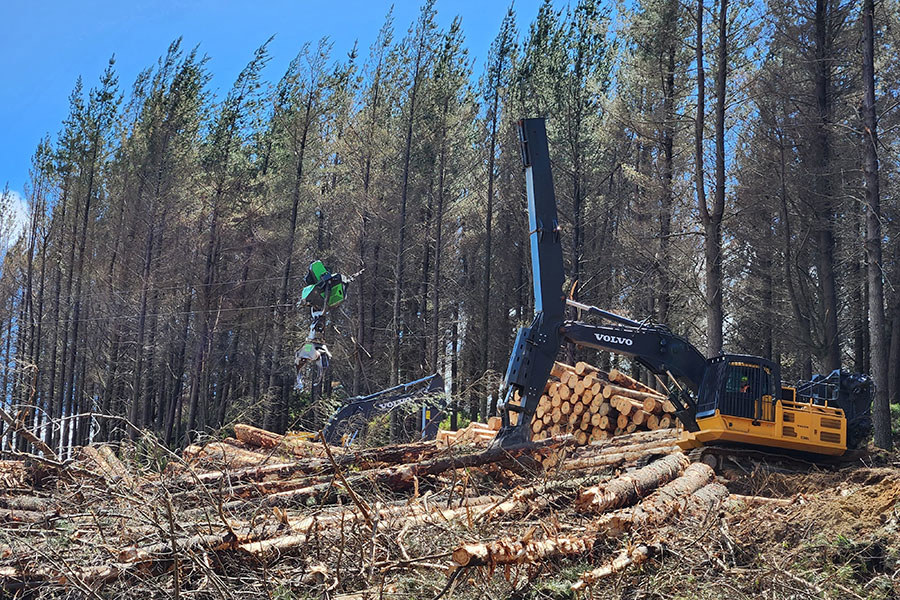
- An automated cable yarder system that aims to control the yarder grapple from a bunching machine in the cutover and extract stems without an operator in the shovel yarder. A hauler control system has been constructed and trialed successfully. The next stage is full-scale implementation of the control system in the feller-buncher.
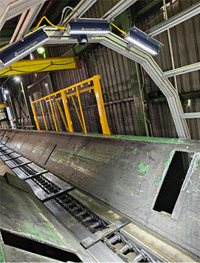
- An automated bark detection and measurement tool. This is designed to measure residual bark after debarking. The system uses three cameras and computer vision to measure the bark on the log and express it as a percentage of log surface area. It provides the operator with a real-time running average of bark percentage to ensure debarking meets the specification for export logs.
- An automated identification system for tracking and tracing logs that eliminates branding and use of log tags. A log marking system is in development that will put a unique code on to the end of a log at the time of manufacture. The code can be read automatically with a log scanner to provide details of harvesting location and date.
- Automated log sweep measurement. This tool mounted on the log processing machine measures the sweep or curvature of each log in real time as it is produced. The sweep is calculated using computer vision as a percentage of the small end diameter of the log.
- Improved residual biomass management using hauler slash grapples designed to pick up harvesting residues. A number of options have been designed and built and are being trialled at present.
- An automated...