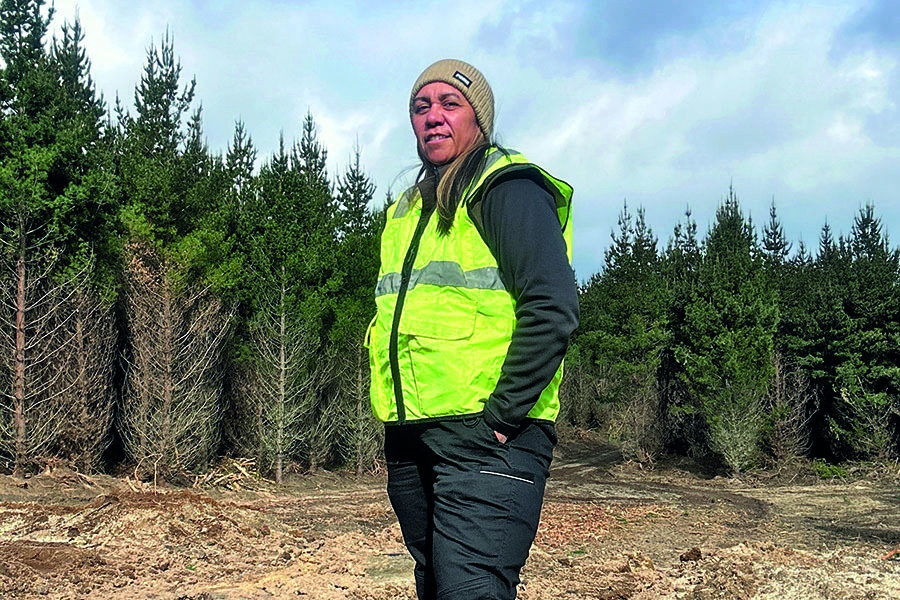
 Cherie Rangiahua’s forestry history dates back to her great-grandfather, Hamuera Rangiahua. He worked for the Fletcher Timber Company, which would later become Fletcher Challenge in Ruatāhuna.
 Her father, Lucky Rangiahua, shared stories of carrying his father’s gas tin for him as an eight-year-old, starting his own forestry journey.
Lucky’s official career began as a forest worker in Tasman. When that role was made redundant, he used the payout to set up on his own. He had a production logging crew in Kaingaroa and Minginui for many years.
Cherie started helping out her dad’s crew during intermediate school – around 1991-93 – first with a tomahawk, delimbing the trees on landing, working her way up to swinging an axe and then log-making with a chainsaw.
It was a family-run business, she says: “There was my brother, my mum, myself, and my younger sister came along later. We also hired a lot of relatives in Murupara and Ruatāhuna. So anywhere between eight to 10 people.”
Cherie started formal training with her dad’s team in 1996. She learned how to use each type of machinery, including doing maintenance at weekends: “Bell Loaders, John Deere Skidders… anything and everything really.”
Production thinning was a big part of the process at the time: “Back in those days, you did a lot of ultra-high pruning. And you would get this extra value out of the log, so you could sell them on the export market. It was a real big moneymaker.”
In 1998 she began her New Zealand Diploma in Forest Management at Rotorua’s Waiariki Institute of Technology.
Upskilling and educating herself have always been important to Cherie, but she says nothing can replace time spent in the forest: “Those early years, that’s where it was instilled in me, to learn a good skill set – basic knowledge that you don’t learn in a classroom.”
Spreading horizons with a woman’s touch
The Asian market crash of 1998 led to the family business folding. Cherie’s dad found work at Waipa Timber – the site now run by Red Stag.
Cherie was still studying and learning sawmilling alongside – getting her tickets for planting, pruning, forest business costings and forest management: “That was pretty complementary to my skill set, giving me the bigger picture of the forestry industry.”
In 2000 she took a job at KLC processing in Kaingaroa village, the first job she got without her dad’s help. It started out as holiday work while she studied until her bosses persuaded her to go full-time.
“I gave up studies for a bit there just to make a bit of money,” she says.
Cherie credits her work ethic as coming from being part of the family crew. Everywhere she went, it was appreciated and rewarded, she says. She also knew that as a female, she needed to keep up with – or ahead of – the boys to be successful.
“You know, my dad was a pretty hard boss. As long as you did your work and did it to a high standard, he pretty much left you alone.”
There was more...