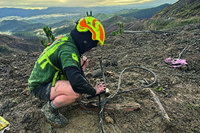
 With slash causing large-scale problems for East Coast waterways following Cyclone Gabrielle, a solution was needed.
In November 2024, global forestry company, Rayonier, authorised the design and build of a large-scale grapple to help with the tidy-up.
Blain Cox and his Hawke’s Bay-based crew, Cox Forestry Services (CFS), agreed to give it a test run.
“We’re a six-man, swing-yarder crew,” says Blain. “My hauler driver’s name is Paulie McRoberts. My crew foreman is Cullum Newman. My processor operator is my daughter, Halle Cox. I have a loader driver, Leo Patio – and a general hand known as Uncle J.”
They are cut-to-length harvesting specialists with a long history together. Cullum has been with CFS for five years, Leo for coming up to 10, and Blain and Uncle J have worked together since the 90s.
The crew uses an EMS Tether Winch machine, a John Deere 859 Feller Buncher, and a tetherable John Deere 909KH with a Waratah 625C Processor.
The trial of the grapple worked well. So much so, Blain says, “there wasn’t enough slash to really use it. So we put it on my hauler and cleaned the creek out”.
One grab and the creek – a higher subsidiary of the Maungahopai Stream – was super clean.
The efficiency of the grapple got Blain thinking: “Sh*t, why don’t I pull wood with (something like) this? It just seemed like a great concept.”
The idea sat with him for around 12 months. During that time, he looked at the nearby terrain, trying to decide how and where he could make the idea work – where he could fly out cut-to-length logs.
“I had to look for suitable ground where there were potential plateaux, where I could set the processor and bring the timber down, to then chop it up, and feed the grapple.”
Blain put his idea to LumberLIFT in Rotorua. They talked through the project’s challenges and went away to do some design work. LumberLIFT produced 3D animated drawings of the grapple holding a scaled-to-size log.
“That looked pretty good to me. So, we pushed the go button, paid a deposit, and it took about nine months for them to make it,” says Blain.
“It cost me just under $100,000 for the bit of steel.”
He says he was at a time in his career when he wanted to challenge himself, and he was determined to try something different.
“With the environmental failures that were happening, I knew it wasn’t a tool that could do everything, but I knew it was a tool that, when you could use it, would be fantastic.”
Once the new kit arrived, he was eager to use it.
An opportunity presented itself, and Blain found an area that was the perfect spot for the trial.
Some uncertainty
There was a sense of general uncertainty at the start of the project, but that fuelled Blain to keep going and make sure the project was a success.
“I hopped on the processor myself for the first two days, and I managed to average just over 41.6 tonnes per hour at 320m.
“Obviously, I recorded all the...